


London’s Salvador Dali of Rave
Post by R.M. team, last updated 25 December 2025
Note: The author's views are entirely his or her own and may not reflect the views of RetoxMagazine.com
Rave-Era Digital Art Revisited
This article visits the work of Junior Tomlin, a pioneering digital artist whose imagery helped define rave culture, early computer game aesthetics, and speculative visual language—at a time when digital art could circulate freely but could not yet be owned.
Long before NFTs, on-chain royalties, and decentralized creator platforms entered mainstream culture, artists like Tomlin were already producing work that was natively digital, endlessly shareable, and culturally influential across scenes.
In London’s rave and electronic music movements of the 1990s, visual art was not a supplement to music—it was infrastructure. Flyers, record sleeves, and posters functioned as signals, identities, and entry points into decentralized cultural networks.
One of the most influential figures to emerge from this era was London-born digital artist Junior Tomlin, widely known as the "Salvador Dali of Rave."
Junior Tomlin
Born and raised in Ladbroke Grove, Junior Tomlin has spent more than three decades working across digital illustration, comics, record covers, game packaging, live events, and film.
His distinctive style blends sci-fi, surrealism, fantasy, futurism, and comic art, producing a body of work that defined the visual language of the rave era. These images travelled widely, often detached from their original context, long before attribution and ownership could be reliably preserved.
Alongside his work in music culture, Junior has contributed digital colouring and illustration to publishers and brands including Marvel, Panini, Titan Books, 2000AD, and John Brown Publishing.
During the 1990s, his record covers and rave flyers were produced in large quantities and distributed freely. Today, many of those same works are considered collectibles—early examples of digital-first art whose cultural value outlasted the formats they were printed on.
What follows is an interview and visual archive that captures how this work was made, how it circulated, and how it evolved across formats. Read today, it offers a clear picture of a digital art economy that existed before the tools to properly support it.
Interview with Junior Tomlin
Today we take the opportunity to explore an artist's creative world. A while ago, we met Junior Tomlin, a graphic designer, concept artist, and design consultant whose style blends sci-fi and fantasy.
Junior began his artistic career in the computer games industry doing packaging artwork, although he started drawing a bit earlier. "I began drawing when my brain came online and have been drawing and designing ever since," Junior explains.
Junior Tomlin: "I have created some of the best-remembered and iconic images associated with dance, rave music, and the digital age, and have inspired many to explore their artistic talents."
Over the years, Junior Tomlin has produced numerous works, including covers for leading dance labels, editorial illustration, rave flyers and posters, earning him the nickname 'Salvador Dali of Rave'—a title worthy of celebration.
Renegade Soundwave Cover Art
Junior Tomlin: "This is a record cover I created for Renegade Soundwave. At the time, I was a lecturer at the London Cartoon Centre, working as an airbrush tutor. The manager of Renegade Soundwave came looking for an airbrush artist for the band. I got the gig and produced three iconic covers for the group. The first was Space Gladiator. The second was Biting My Nails, a remix of their 7" single; I provided a few sketches, and the one seen here was chosen. It was finally produced on A0 line board in airbrush."
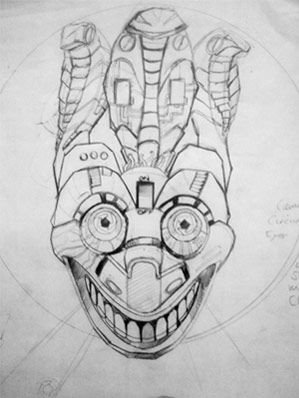
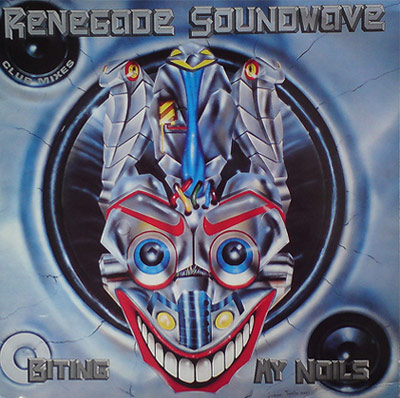
Record cover for Renegade Soundwave.
Junior Tomlin: "This image originated from a larger penciled piece for Renegade SoundWave. The original drawing depicted the three band members, which I had a photograph of. Some time later, I decided to add color. This piece was used for two rave flyers: one called Ravealation and the other Dream. It was also exhibited at the Ministry of Sound."
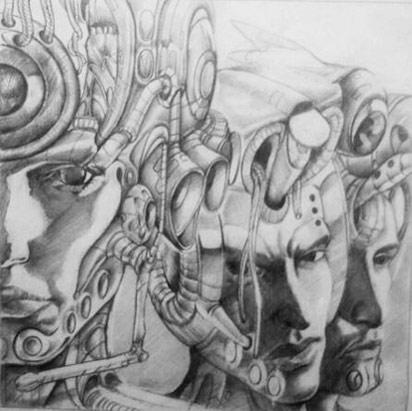
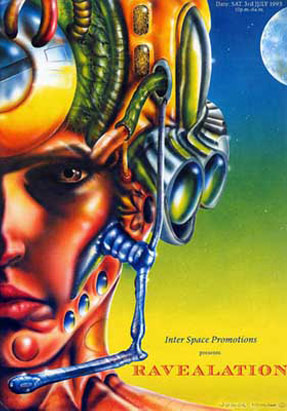
Larger penciled piece for Renegade SoundWave. The original drawing as well as the later colour piece.
Over the years, Junior Tomlin has worked in the film industry, including Nightbreed, Lost In Space, and The Fairy King of Ar. He has also contributed digital colouring for Titan Books, 2000AD, Marvel Comics, and John Brown Publishing.
Junior Tomlin: "I have coloured many of the world's best-loved comic strips, including Judge Dredd, Transformers, Teenage Mutant Ninja Turtles, and Spider-Man, and have worked for the BAFTA award-winning Audio Rom."
We asked what inspires him and fuels his creative process. "I draw inspiration from many places: art, photography, sculpture, architecture, science, and I am a lover of film and comics."
Death of the Euro
Junior Tomlin: "Death of the Euro is a political piece. It came about because of the ongoing troubles with the Euro and the repeated bank bailouts that failed. The roots of this piece trace back to an earlier work I named The Cosmic Man, originally created for a rave called Dream Zone."
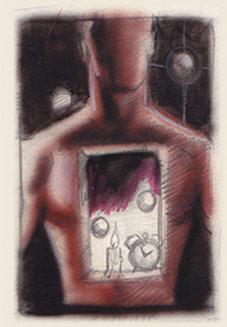
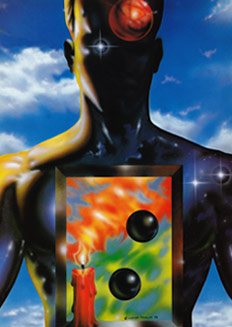
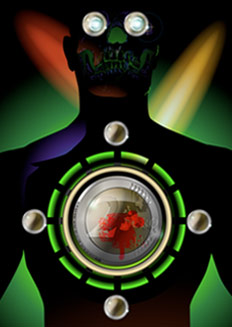
Death of the Euro tracing back to an earlier work named The Cosmic Man.
The Find
Junior Tomlin: "The next image is named The Find. I had the preliminary sketch for this one while working in Soho at a company called Amgfx. It was a production illustration: one robot finds another in the mountains; it had long been deactivated, and he touches it tentatively as he looks into its non-functional eyes. This was a digital piece."
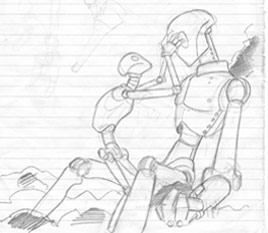
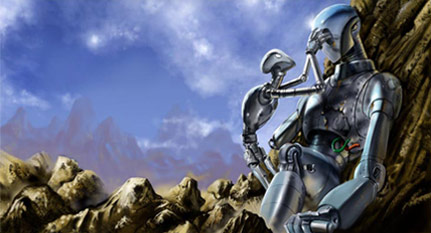
The preliminary sketch for The Find and the final illustration."
Junior Tomlin: "The preliminary sketch for The Find was done in pencil in a lined notepad while I was working at Amgfx as a texture map artist. The sketch was a production illustration for a project called Ergo."
Tomlin’s work demonstrates that digital art was already decentralized in practice. Images moved between scenes, were repurposed across media, and accumulated cultural value without central authority control.
In recent years, renewed interest in blockchain-based art has prompted a re-examination of artists whose work highlights a long-standing gap between creative output and sustainable ownership—a gap that decentralized technologies now attempt to address.
Junior’s legacy work has since been documented in print, including a monograph published by Velocity Press, preserving an era of digital culture that predates Web3 but strongly resonates with it.
From Digital Art to Decentralized Culture
Rave culture functioned as a decentralized network long before the term existed. Events were organized peer-to-peer, visuals spread organically, and cultural value emerged without centralized platforms or gatekeepers.
This body of work illustrates a long-standing gap between cultural influence and sustainable ownership. Blockchain-native creative ecosystems now seek to address that gap, enabling artists to establish verifiable authorship, direct relationships with audiences, and long-term preservation of digital work.
Rather than replacing earlier creative practices, blockchain extends them—offering new infrastructure for artists whose work was already digital, already shareable, and already global.
Looking back at moments like this helps contextualize today’s blockchain art movement not as a sudden disruption, but as a continuation of underground digital culture—one that finally gives artists tools for attribution, ownership, and long-term value.
RECENT STORIES

Discover the work of Junior Tomlin, a key figure in London’s 1990s rave scene. From…

Luxury fashion embraces blockchain, NFTs, and digital innovation.

Explore the Takhini Hair Freezing Contest, where icy creativity meets real-world…

Abbey Road became a global cultural landmark through one iconic photograph endlessly…

Explore virtual beach travel destinations and how blockchain gives digital beaches…

Haircuts are no longer private routines—they’re shared online as tutorials, videos,…

Facial hair has moved from private grooming to a shared digital culture. Tutorials,…

From private jet mishaps to DIY ocean voyages, extreme travel adventures capture…

Explore how unusual viral moments, from global toilet paper thefts to quirky cultural…

Frieze Sculpture returns to London's Regent’s Park showcasing artworks of over 20…